Japanese Crystal vs Standard Whisky Glasses: Is the Upgrade Worth It?
By: Callum Ashworth
That Ring When You Tap It: What It Actually Means
Tap a standard whisky glass with your fingernail and you get a flat, dull thud. Tap a crystal glass and you get a clear, sustained ring that hangs in the air for a second or two. This is the most immediate, tangible difference between the two materials, and it tells you something real about what you're holding.
The physics are straightforward: crystal has lower internal damping than soda-lime glass, so vibrations travel through it more freely and last longer, producing a purer, bell-like tone. According to Wikipedia's entry on lead glass, British and Irish crystal wine glasses of the 17th to 19th centuries were prized for their "rich bell-notes of F and G sharp." The ring has always been a quality signal.
Modern lead-free crystal retains a similar ring thanks to its mineral composition, so you don't lose the acoustic quality by removing lead. This is a demonstrable, repeatable difference you can test yourself. Below, we cover clarity, weight, sound, grip, durability, and price, with an honest verdict at the end.
What Does 'Crystal' Actually Mean on a Whisky Glass Label?
Most whisky glasses labelled "crystal" today contain no lead at all. This is worth stating plainly, because the word carries a lot of historical baggage that can mislead buyers.
Traditional lead crystal used lead oxide to achieve its weight, clarity, and that characteristic ring. Modern Japanese crystal replaces lead oxide with alternatives such as barium oxide, potassium oxide, or zinc oxide. The result is comparable optical and acoustic performance without any health concerns. As GoGlassCup notes, lead-free crystal is not a compromise; it's an engineered improvement.
The labelling rules don't help matters. In the EU, a glass product must contain at least 24% mineral content to be called "crystal." In the US, the FTC allows "crystal" labelling even for glass with minimal or no lead, provided it's marketed as "lead-free crystal." This regulatory ambiguity is a key reason the label can feel meaningless.
A concrete reference point: K9 crystal is the specific formulation used in premium Japanese Edo Kiriko-style glasses. It's a lead-free optical glass with a high mineral content, and it's the material you'll find in Chapter 84's Japanese crystal collection. When you see "crystal" on our labels, that's what it means: K9 lead-free crystal, not traditional leaded glass.
Clarity and Light: The Optical Difference You Can See
Numbers first. Standard soda-lime glass has a refractive index of approximately 1.46 to 1.49. K9 crystal, as used in Edo Kiriko-style glasses, sits at approximately 1.52, according to ClayWhispers. In plain terms, the higher the refractive index, the more the glass bends and scatters light. That's what produces the sparkle and colour play you notice when light hits a crystal glass.
The Edo Kiriko tradition makes the most of this property. Originating in Tokyo (then Edo) in the 1830s, Japanese artisans adapted European glass-cutting techniques, including British methods, to Japanese aesthetic sensibilities. The craft was designated a Traditional Japanese Craft in 2002. There's a fascinating historical link here: British craftsmen introduced Western cutting methods to Japan, and the craft that now defines Japanese crystal glassware has British roots.
Hand-cut Edo Kiriko patterns (Asanoha, Kikkō, Seigaiha, and others) involve dozens to hundreds of individual facets, each at a slightly different angle. This produces a complex, shifting sparkle that machine-cut glass simply cannot replicate. The light moves differently every time you turn the glass in your hand.
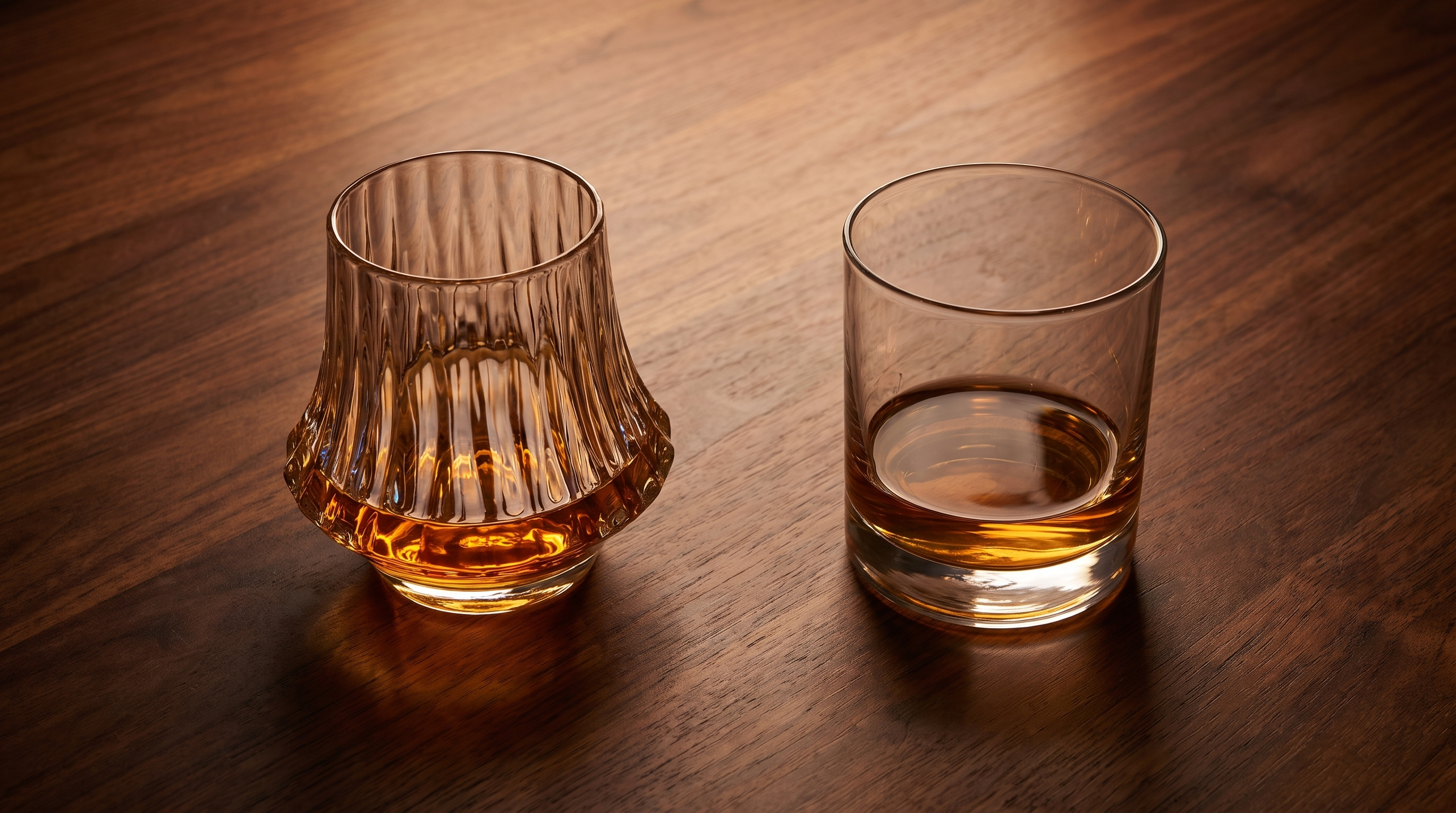
A word of honesty: if you're pouring a quick dram in dim light, this difference may be subtle. For display, gifting, or a considered tasting ritual, though, it is genuinely striking. Pour a measure of amber whisky into a cut crystal glass, set it on a table near a window, and you'll see what we mean.
Weight, Grip, and the Feel in Your Hand
Crystal is denser than standard soda-lime glass. Pick up a crystal whisky glass and you'll notice a heavier, more substantial feel immediately. It's the kind of weight that signals quality before you even take a sip.
The cut patterns on Japanese crystal glasses serve a dual function that often gets overlooked. They create prismatic light refraction, yes, but they also provide a practical, enhanced non-slip grip. Geometric cuts such as diamond and hexagonal patterns create natural friction points against your fingers. This is a functional benefit, not just decoration. Kanpai Navi highlights this dual purpose in their guide to Japanese whisky glasses.
Compare the feel of holding a standard tumbler (lighter, smoother, less feedback) versus a cut crystal glass (weighted, textured, deliberate). The difference fits neatly into the "slow living" and mindful drinking movement that has gained real traction in recent years. According to DataIntelo, 62% of whisky enthusiasts now consider glassware a critical part of their tasting ritual, up from 44% in 2020. The physical experience of the glass is part of the ritual, not separate from it.
That said, to be honest: if you're pouring a quick dram while watching television, the grip and weight difference won't change your evening. For a considered pour, though, it genuinely does.
Durability: Which Glass Actually Lasts Longer?
There's a common assumption that crystal is fragile. It's understandable, but it's outdated. Traditional leaded crystal is softer and more prone to scratching and chipping. Modern lead-free crystal is a different story entirely.
The data is concrete: traditional leaded crystal lasts 14 to 18 months under heavy commercial use before aesthetic or functional decline. Premium lead-free crystal lasts 32 to 40 months under identical conditions, according to Alibaba product insights. That's more than double the lifespan.
Lead-free crystal also reduces thermal expansion rates by up to 22% compared to traditional leaded crystal. In practical terms, it's more resistant to cracking from temperature changes, such as pouring a cold dram into a glass that's been sitting in a warm room.
Standard soda-lime glass is robust for everyday use, but it lacks the optical and acoustic properties of crystal. It's a trade-off, not a straight win for either material. For a gift meant to be kept and displayed rather than used daily and replaced, the durability of lead-free crystal is a genuine advantage.
For gift buyers, transit matters too. At Chapter 84, every glass is hand-inspected and double-boxed in reinforced packaging before dispatch. With over 41,000 decanters delivered across the UK and a high satisfaction rate, we know that quality glassware deserves quality protection.
Price: What Does the Upgrade Actually Cost?
To be transparent: authentic hand-cut Edo Kiriko whisky glasses from Japanese artisan studios typically retail between £120 and £320+ per glass. These are genuine artisan pieces, and the price reflects the hours of hand-cutting involved.
Japanese crystal-style glasses at the accessible mid-range, such as those in Chapter 84's collection, sit considerably lower. They use the same K9 crystal material and draw on the same cut patterns, making the aesthetic and material upgrade achievable without the artisan price tag.
Standard whisky glasses range from around £8 to £25 for decent soda-lime options. The jump to mid-range crystal is meaningful but not prohibitive, especially in a gifting context. For a casual drinker who uses a glass daily and doesn't think much about it, a standard glass is a perfectly reasonable choice.
For an enthusiast, a collector, or someone buying a gift for a significant occasion (birthday, Father's Day, retirement, best man gift), the extra spend buys something that looks, feels, and sounds different in a way that is immediately noticeable. Searches for "unique whiskey glasses" have surged by 156% according to ClayWhispers' 2026 analysis, and crystal directly addresses that demand.
Chapter 84's multi-buy savings (20 to 30% off, applied automatically at checkout) and free UK-wide delivery make the upgrade more accessible than it might first appear. If you're buying a set rather than a single glass, the per-glass cost drops meaningfully.
So, Is the Upgrade Worth It?
Here's the honest answer: it depends on who the glass is for.
For casual drinkers, a standard glass holds your dram perfectly well, and there's no shame in that. The whisky is the star. You don't need crystal to enjoy a good pour.
For enthusiasts, collectors, and gift buyers, the differences are real and measurable. A higher refractive index means more light play. Lead-free crystal means safer and more durable. Cut patterns mean better grip and more visual complexity. And that ring when you tap it tells you, and everyone nearby, that this is not an ordinary glass.
The gifting case is particularly strong. A Japanese crystal whisky glass is a statement piece that communicates thought and quality in a way a standard glass simply cannot. It's the kind of gift that gets kept on a shelf, not pushed to the back of a cupboard.
Explore Chapter 84's Japanese Crystal Whisky Glasses collection and see for yourself. Free UK-wide delivery, 30-day returns, and multi-buy savings are all part of the deal. The upgrade is worth it if the glass matters to you. And for the right person, it really does.
Sources
- Wikipedia: Lead Glass
- GoGlassCup: Benefits of Lead-Free Crystal Glass
- ClayWhispers: Is a £150+ Whisky Glass Worth It? Edo Kiriko Art & Science
- Oriental Artisan: Edo Kiriko Whisky Glass Guide
- Kanpai Navi: Japanese Whiskey Glass Guide
- DataIntelo: Whisky Glasses Market Report (2025–2034)
- Alibaba Product Insights: Crystal vs Lead-Free Glassware Durability
- ClayWhispers: The Best Whiskey Glasses of 2026